Tuesday, March 4, 2014

Biomolecules — Proteins

Amino Acids:

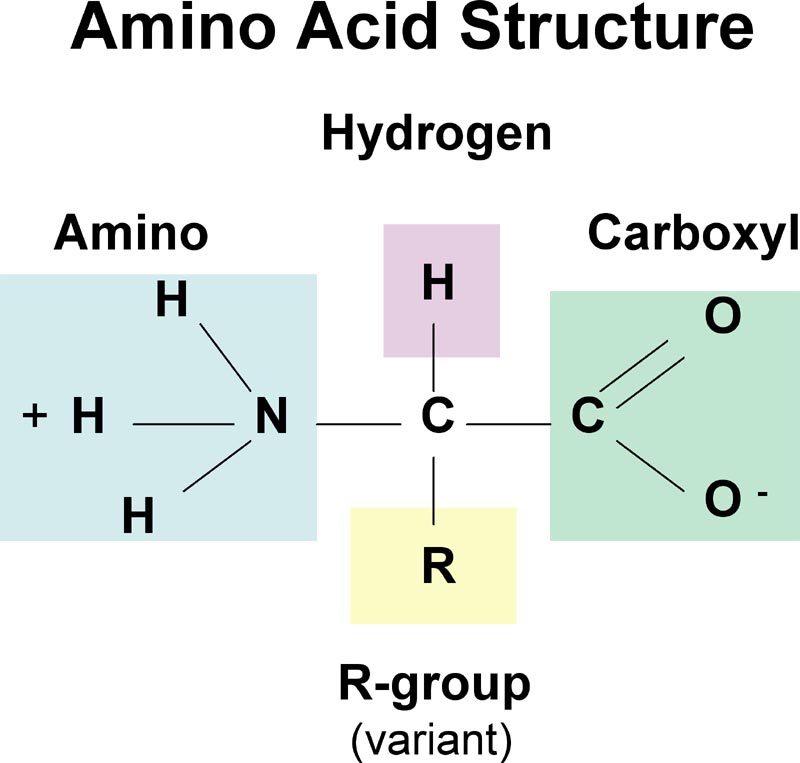
The basic building blocks of proteins are amino acids. Amino acids are the monomers which form polypeptide and proteins.
Properties of Proteins:
  • sensitive to pH and heat
  • shape determines function
  • enzymes are special group of proteins
  • contain H, N, C and S
  • made up of amino acids
There are about 20 essential amino acids found in proteins, and they differ in their R group. 

Amino acids join together to form a polypeptide through the process called condensation.

Two amino acids are joined by a peptide bond to form a dipeptide via condensation. Water is formed as a by product. 

The reaction is between an amino group and a carboxyl group. 

Continued condensation leads to the addition of more amino acids and thus resulting in a polypeptide chain.


Structure of proteins:
  1. Primary structure --> specific linear order which amino acids join to form a polypeptide chain
  2. Secondary structure --> regular folding of segments by hydrogen bonds (α-helix and β-pleated sheet)
  3. Tertiary structure --> (only for globular proteins) overall shape of polypeptide resulting from interactions* between the R group 
  4. Quaternary structure --> association of 2 or more polypeptide chains 
*Bonds that form tertiary structures:
  • hydrogen bonds
  • ionic bonds
  • disulfide bonds
  • hydrophobic interaction
Classification of proteins (based on structure):
  • Globular --> compact and spherical structure which is soluble
  • Fibrous --> long polypeptide chains twisted around each other, forming long fibres that provide tensile strength, insoluble 

Sunday, February 16, 2014

Cell Transport

Passive transport (requires no ATP as molecules move along a concentration gradient):
  • Simple Diffusion
  • Facilitated Diffusion
  • Osmosis
Active transport (requires ATP as molecules move against a concentration gradient):
  •  Endocytosis
  •  Exocytosis
  •  Pinocytosis (“drinking”)
  •  Phagocytosis
Simple Diffusion
  • Net movement of molecules in and out of the cell along a concentration gradient
  • Eg. gas exchange during photosynthesis, gas exchange at the alveoli 
Facilitated Diffusion
  • Movement of specific molecules down a concentration gradient through specific carrier proteins
  • Molecules that move by facilitated diffusion include glucose and amino acids
Osmosis

  • Net movement of water molecules from a region of higher water potential to a region of lower water potential, across a partially permeable membrane
  • Eg. absorption of water by plant roots


credits to: http://www.biologymad.com/resources/diffusionrevision.pdf

Cell membrane structure

Function of cell membranes:
  •      To compartmentalize the cell --> separate different enzymes of different organelles and prevent autolysis
  •      Control entry and exit of substances
  •      Increases surface area for exchange of substances
  •      Cell recognition
  •      Cell communication
  •      Site of chemical reactions (eg. light reactions of photosynthesis)


Fluid mosaic model


The cell membrane consists of:
  • phospholipids --> head is polar while tail is non-polar 
  • proteins --> peripheral/integral proteins 
  • glycoproteins (consists of carbohydrate chains bound to peripheral proteins and hydrophilic regions of integral proteins) 
  • cholesterol --> maintains membrane fluidity


Cell Structure — Animal cell vs Plant cell

Animal Cell structure


Plant Cell structure

credits to: http://www.diffen.com/difference/Animal_Cell_vs_Plant_Cell


Biological Molecules - You Are What You Eat: Crash Course Biology #3


A helpful video on biomolecules!


 ← screengrab from the video!